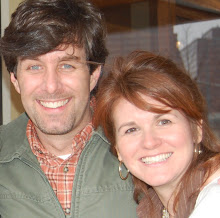
This past weekend at the Dahlonega Church Plant "video premier" at Perimeter, we had the opportunity to interview some good friends of ours from Atlanta, Brittany and Joe McDonald. Enjoy.
Friday, February 6, 2009

Thursday, February 5, 2009
Repentance
A very close friend of mine emailed me the other day asking for a definition of repentance. Hmmm...
I heard someone say that repentance is spiritual and moral honesty. Meaning, in repentance I admit that I am a real sinner, and not just one in theory. That's good (not the sin, but the honesty!). For Stanley Voke, a working definition of repentance is "sitting in the sinner's place." I really like that.
Anyway, the Greek word for repentance, metanoia, means "to change one's mind" or "to turn." The standard explanation is that when we repent, we change... we commit to stop doing bad stuff and to start doing good stuff. Some say it this way: "Repentance is turning from your sin to following Jesus." However, I think that this explanation misses the teaching of John the Reformed Baptist, who said that the Pharisees should "produce fruit in keeping with repentance." The fruit (the change) is not the repentance... it is the result of repentance.
So let me twist the phrase a bit, and say it this way... Rather than turn from my sin to Jesus, I am to turn with my sin to Jesus (or to anyone else whom I have sinned against). The change of mind is that I am the sinner. I am wrong. I deserve justice. And so to repent with faith is to turn with my sin to Jesus believing that he takes my sin upon himself on the cross and, in turn, clothes me with his perfect righteousness. Then I am filled with the Spirit and enabled to see the fruit (change) of repentance, which is nothing other than the fruit of the Spirit working in my life as I go to the sinner's place and find grace.
So the problem with my lack of practical change, is not a lack of trying harder to change, but a lack of repentance (not penance) combined with faith.
I heard someone say that repentance is spiritual and moral honesty. Meaning, in repentance I admit that I am a real sinner, and not just one in theory. That's good (not the sin, but the honesty!). For Stanley Voke, a working definition of repentance is "sitting in the sinner's place." I really like that.
Anyway, the Greek word for repentance, metanoia, means "to change one's mind" or "to turn." The standard explanation is that when we repent, we change... we commit to stop doing bad stuff and to start doing good stuff. Some say it this way: "Repentance is turning from your sin to following Jesus." However, I think that this explanation misses the teaching of John the Reformed Baptist, who said that the Pharisees should "produce fruit in keeping with repentance." The fruit (the change) is not the repentance... it is the result of repentance.
So let me twist the phrase a bit, and say it this way... Rather than turn from my sin to Jesus, I am to turn with my sin to Jesus (or to anyone else whom I have sinned against). The change of mind is that I am the sinner. I am wrong. I deserve justice. And so to repent with faith is to turn with my sin to Jesus believing that he takes my sin upon himself on the cross and, in turn, clothes me with his perfect righteousness. Then I am filled with the Spirit and enabled to see the fruit (change) of repentance, which is nothing other than the fruit of the Spirit working in my life as I go to the sinner's place and find grace.
So the problem with my lack of practical change, is not a lack of trying harder to change, but a lack of repentance (not penance) combined with faith.
Wednesday, February 4, 2009
Dahlonega Church Plant Featured at Perimeter
This past weekend at Perimeter the Dahlonega Church Plant was featured at all the weekend services with a vision video and by having our family introduced on stage. Bob Cargo, the director for church planting at Perimeter, introduced us and prayed for us. We also had an information table set up in the main lobby where we enjoyed talking to many, many folks—lots of whom were very enthusiastic about the new church. Several high school seniors who will be attending NGCSU introduced themselves. Needless to say, we are very excited about doing ministry in a college town!


Tuesday, February 3, 2009
The Second Look
I came across a hymn of John Newton today (I don't know the title, only the words), in which his eyes fix twice on those of Jesus on the cross. The first look overwhelms him with guilt and shame, but the second convinces him of God's immeasurable grace and complete forgiveness. That is the law (the first look) driving him and me to the gospel (the second look), and is why I need to spend time meditating on the cross of Jesus. I first need to feel the pain of my sin so that I more deeply can experience and appreciate the hight, depth, width, and breadth of God's amazing grace toward and love for me in Jesus. It is encountering such grace that not only consoles me, but changes me. So don't miss the second look!
In my sin I took delightLet me emphasize it again to my own heart: do not miss the second look, but gaze and gaze upon him who is my Savior and Priceless Treasure.
Unawed by shame or fear
Until a new object met my sight
And stopped my wild career
I saw one hanging on a tree
In agony and blood
Who fixed his languid eyes on me
As near his cross I stood
Sure never til my last breath
Will I forget that look
It seemed to charge me with his death
Though not a word he spoke
My conscience owned and felt my guilt
And plunged me in despair
I knew my sins his blood had spilt
And served to nail him there.
A second look he gave which said
I freely all forgive
My blood was for your ransom paid,
I died that you may live.
Monday, February 2, 2009
Functional vs. Devotional Prayer
According to Myers-Briggs, I am an INTJ, which means that I like "alone time." So did Jesus. Listen to Mark 1:34 and Matthew 14:23:
"Very early in the morning, while it was still dark, Jesus got up, left the house and went off to a solitary place, where he prayed.... After he had dismissed them, he went up on a mountain by himself to pray."
The problem is that when I get to that gloriously solitary place, I tend not to pray, but to plan. But Jesus prays. He knew he needed to draw strength from his relationship with the Father. But many times I live like an orphan who has no Father. That probably is why I plan so much and pray so little.
But a real relationship with the Father (not religion, not ritual, and most certainly not guilt or duty) is what fuels real prayer. When I know God as a Father who would send his own beloved Son, Jesus, to reconcile me to himself by dealing with the penalty of my sin on the cross, the motives for my time with God change. I know myself as a runaway, spiritual orphan, who has been adopted in love. I am the guilty offender who has been declared righteous. I am the enemy who is now a friend. I am the unlovely and unloveable sinner who has been made beautiful in the sight of God. All though Jesus. All by grace.
It is embracing this gospel that transforms prayer from being primarily a functional list of requests (where I use God) into being a devotional relationship characterized by trust, hope, love, joy, etc. (where I enjoy God). So the call on my life today is not to try harder to pray better, but to look upon the love of God in the cross. Then prayer will not be something that I have to do, but something that I get to do.
Saturday, January 31, 2009
A Six-Pack of Core Commitments
As I have thought and thought about the core commitments for a new, gospel-centered church in Dahlonega, there are four core commitments that I see guiding the ministry. The original post had four commitments, but in the past few days I have added two more that I think are essential. So here is the six-pack of core commitments:
#1- IMPASSIONED ORTHODOXY
We will be committed to the Bible as our standard for theological orthodoxy, which is not an end in itself, but is a means to knowing and enjoying God.
#2- RADICAL GRACE
We want the radical message of grace to be the central theme that permeates the church’s worship, teaching, leadership, discipleship, mission, etc.
#3- AUTHENTIC COMMUNITY
We long for a grace-saturated atmosphere that communicates to people, “This is a safe place to be real. We are all broken, sinful people who desperately need Jesus.”
#4- INTENTIONAL DISCIPLESHIP
Utilizing both structured and unstructured aspects of equipping believers as followers of Jesus, at the heart of our mission is an intentional approach to grace-centered, life-on-life discipleship.
#5- HOLISTIC COMPASSION & JUSTICE
A holistic gospel compels us to minister holistic compassion and justice, not only serving spiritual needs, but also meting physical and material needs.
#6- ORGANIC MISSION
We will encourage all the folks in the church to see themselves as missionaries, word and deed ambassadors of the gospel living as “salt and light” in the context of their organic spheres of influence.
#1- IMPASSIONED ORTHODOXY
We will be committed to the Bible as our standard for theological orthodoxy, which is not an end in itself, but is a means to knowing and enjoying God.
#2- RADICAL GRACE
We want the radical message of grace to be the central theme that permeates the church’s worship, teaching, leadership, discipleship, mission, etc.
#3- AUTHENTIC COMMUNITY
We long for a grace-saturated atmosphere that communicates to people, “This is a safe place to be real. We are all broken, sinful people who desperately need Jesus.”
#4- INTENTIONAL DISCIPLESHIP
Utilizing both structured and unstructured aspects of equipping believers as followers of Jesus, at the heart of our mission is an intentional approach to grace-centered, life-on-life discipleship.
#5- HOLISTIC COMPASSION & JUSTICE
A holistic gospel compels us to minister holistic compassion and justice, not only serving spiritual needs, but also meting physical and material needs.
#6- ORGANIC MISSION
We will encourage all the folks in the church to see themselves as missionaries, word and deed ambassadors of the gospel living as “salt and light” in the context of their organic spheres of influence.
Thursday, January 29, 2009
Encouragement for the Dehydrated
Yesterday during the panel discussion at the GCA church planting conference, a question was asked concerning the most critical factor in church planting. Most of us expected the response to be tactical. There must be some magic "how to" that if perfected would guarantee success. The answer was not tactical. Rather, it was devotional. Ted Powers took the mic and said that the most critical factor for the church planter is his own abiding in the Vine/Jesus/the gospel (John 15:4-5). A church planter wants others to receive and rest in the grace of God in the gospel. However, the most important thing is that the church planter himself receive and rest in the grace of God in the gospel. As I reflected on this, I realized that the application is wider than just for a church planter. It applies to every Christian. For example, the most significant factor in the health of my marriage is whether or not I am abiding in Jesus as my righteousness. The same is true for anyone's role as a parent, student, athlete, etc. For the athlete, an analogy might be hydration. If I am not hydrated, I will become dehydrated and, eventually, will give out on the field. The same is true as a Christian. As one who finds himself dehydrated far too often, I need to be reminded of my desperate, daily need of the hydration of God's love and grace to me in Jesus through his life, death, and resurrection. My greatest need is not primarily tactical, it is devotional. I need the hydration of the beauty, wonder, and power of the gospel.
Tuesday, January 27, 2009
What to Pray
Sometimes I want to pray for folks, but I'm just not sure what to pray. So my prayer often is limited to something generic like, "Bless so and so." Now God knows what to do with that. But if prayer is going to be a means of grace for the one praying (me), then maybe it would be helpful to get a bit more specific, and more Jesus/gospel/grace-centered.
While I was sitting in a seminar today on gospel-centered preaching, the instructor said that if I was struggling with how to pray for folks beyond, "Bless _______," then I could pray the prayer of Paul in Ephesians 3:14-21 (or any other Scriptural prayer). What a great idea! I think I am going to start praying this for myself, family, and the folks whom I pray, by God's grace, we will reach through the church plant in Dahlonega.
"For this reason I kneel before the Father,from whom his whole family in heaven and on earth derives its name. I pray that out of his glorious riches he may strengthen you with power through his Spirit in your inner being, so that Christ may dwell in your hearts through faith. And I pray that you, being rooted and established in love, may have power, together with all the saints, to grasp how wide and long and high and deep is the love of Christ, and to know this love that surpasses knowledge--that you may be filled to the measure of all the fullness of God. Now to him who is able to do immeasurably more than all we ask or imagine, according to his power that is at work within us, to him be glory in the church and in Christ Jesus throughout all generations, for ever and ever! Amen."
Monday, January 26, 2009
Life Out of Death
At the risk of sounding like a broken record (or a scratched CD), I am going to post one more thought from Stanley Voke's Personal Revival. The theme of brokenness has so gripped me that it seems like I have had a gravitational pull toward that topic lately. Don't get me wrong, I do not want to be broken, and there is more to talk about. But having experienced a little brokenness (and being a slow learner who needs to hear the same thing over and over), I find Voke to be so helpful and encouraging. So please forgive the redundancy.
"God blesses all he breaks. Victory came to Gideon's army when the pitchers were broken to release the light within them. Fulness came to the five thousand when Jesus broke the loaves that seemed so few. Fragrance poured through all teh house when a box of ointment was broken over the Savior's feet. It all happened in the breaking. When the Son of God was broken in the darkness... of the cross, Satan was overthrown, sin was dealt with, the Gospel set free and eternal life released for all the world. Calvary proves the principle that God always blesses brokenness, for he brings life out of death."
Saturday, January 24, 2009
The Requirement of Brokenness
Today I heard Tim Keller relate a story about several pastors talking in England about a young preacher who was taking the country by storm. Strong, authoritative preaching. As the men discussed this younger man's success, one of the older pastors remarked, "Yes, but I do not think that he has been broken yet." I suppose he was getting at the idea that grace can only flow through a broken vessel. So is it possible that brokenness is not a liability after all, but actually a requirement for effective ministry? Something to think about. Anyway, those remarks echo the words of Stanley Voke, who, in his book, Peronal Revival, said,
"God knows how much we need to be broken, so He uses people and situations to humble us that we might be brought wounded and helpless to the foot of the cross."
Brokenness is painful. No one chooses that path. However, what an encouragement it is to know that God plans those hard things in our lives in order that we might experience more grace, more love, more Jesus... and in turn, be much more effective "witnesses" to the beauty, wonder, and power of the gospel.
Friday, January 23, 2009
My Challenge
There is an article by World Magazine columnist Andree Seu that I keep in my Bible and pull out quite often. She writes,
"In normal times one tends to derive one's security from notoriously losable things, even while continuing to believe that one has placed one's house squarely on the Rock. If you are a child of His, God will not let that state of affairs persist indefinitely."
Seu is piggy-backing off of German pastor-martyr, Dietrich Bonhoeffer, who said, "The disciple is dragged out of his relative security into a life of absolute insecurity." This is the place from which I tend to run. I want safety. Comfort. Security. But as Seu says, "There is no place than on this scary adventure that we learn to trust Jesus." Whether it is the flood of my sin or the stress of circumstance, I am called to live by the saving and sustaining grace of God. And part of living by grace is learning to live by grace. That is my challenge today: to believe the promises of God in the gospel, experience rest, and walk in the security of the Savior's shadow (Ps. 91:1).
Wednesday, January 21, 2009
A Gospel Reminder
I received an email today from a friend, Dave McCarty. Some people are preachers, some evangelists, and others leaders, exhorters and motivators. Dave is a gospel reminder. And I am thankful for him and his ministry of reminding me of my need for Jesus. In his most recent email "reminder," he writes:
"Only the deeply wounded who realize their woundedness, those with a deep sense of failure, can deeply appreciate The Healer... and can experience the ecstasy of His unconditional love, to the point where everything else in this world, pales by comparison. The gift of... His presence is incomparable to the hurting, the needy, the loser, the nobody, the dysfunctional, who is self-aware. The work of the Spirit is to make us self-aware."
This "reminder" reminded me of how spiritually blind I am most of the time. So UNaware of my need, because I am always trying to be strong, able, mature and self-protective... and therefore, I am UNaware of the grace, love and spiritual power that is available to me in the gospel. And so my prayer today is that I would be freshly aware of my woundedness, failure, weakness and need, so that I would find, cherish, and enjoy Jesus as my all-sufficient Savior, Healer, and Lover of my soul.
Tuesday, January 20, 2009
Don't Miss Jesus
In his book, Objects of His Affection, Scotty Smith says,
"It's one thing to go to church, but quite another to go to Jesus."
Now, these are not mutually exclusive. We can, I hope, "go to church" and "go to Jesus." But I can relate to just "going to church." I know what it is to be compelled by religious duty. This can also happen in the evangelical "quiet time." The point is that I can go through the religious motions, and still miss Jesus—because religious motions are about what I do, while the gospel essentially is about what Jesus has done. So I suppose the distinction between religious activity and true spirituality is that the religious life is driven by guilt and duty, while the life of being a disciple of Jesus is driven by grace. So my prayer today is that whether "in church" or in my "quiet time," or in whatever I'm doing, that I would experience a living, vital, faith-filled, grace-dependent communion, not with a religious duty, but with Jesus.
Monday, January 19, 2009
Grace Flows Downhill
James Proctor wrote a hymn entitled "It is Finished" that has a stanza which speaks to a very real need in my heart. This is because I am a "recovering Pharisee (legalist)" who by default lives by performance rather than by grace. Sometimes I fall off of the wagon by living as if my "doing" secures my "being" forgiven, accepted and loved by God. However, the gospel tells me that my "being" forgiven, accepted and loved comes before any "doing" on my part. I am reconciled to God, accepted, declared righteous and loved, not because of anything good I have done. I do nothing— no thing. Jesus does it all. He does every thing necessary for my salvation as a dearly loved and adopted son. And so if I think my doing either secures or sustains my position before God, my doing becomes deadly. That is why Proctor's hymn helps to set me free, loosening the chains of legalism, guilt and duty. As if speaking to me, he says,
"Lay your deadly doing downDown at Jesus' feetAnd stand in Him, in Him alone,Wondrously complete."
Sunday, January 18, 2009
The Question for Today
I just can't get enough of Stanley Voke. Here is a bit more from his chapter in Personal Revival entitled, "The Way Up is the Way Down."
"We have to continually take this lowest place.... [However] we want to be strong in ourselves, popular and powerful like Absalom, rather than poor and crippled like Mephibosheth, who was obliged to live by the grace of King David."
The question for me today is this: Will I live by the grace of King Jesus? The fact is that I am more crippled than I want to admit—far more crippled. But He is more able to heal than I am able to imagine—far more able... and far more willing.
Saturday, January 17, 2009
The Way Up is the Way Down
I am re-absorbing the late Stanley Voke's book Personal Revival: Living the Christian Life in the Light of the Cross. It is gospel gold. In his opening chapter entitled, "The Way Up is the Way Down, Voke writes:
Zacchaeus had to come down from his tree to find salvation. Peter came down from his boat to walk on teh water to Jesus. Lepers and blind men came down to the Lord's feet to find healing. Prophets and apostles found the fulness of the Holy Spirit as they lay prostrate before God. The last church in Revelation was promised rightousness and riches when she took the place of poverty, blindness, nakendness and need. In each case, the way up was the way down.... This is where we must come if grace is ever to reach us."
Quoting the Old Testament, Peter said it like this, "God opposes the proud, but gives grace to the humble." Or as Jack Miller used to say, "Grace flows downhill."
Friday, January 16, 2009
The Sinner's Place
In Stanley Voke's wonderful book, Personal Revival: Living the Christian Life in Light of the Cross, he talks about the significance of "the sinner's place." He says, "The hardest thing for anyone is to take the sinner's place." Simply put, "the sinner's place is where [I] take blame."It is the place where I am real, honest, authentic, and vulnerable. While I naturally resist that place with all my might, the Spirit guides me (sometimes pushes me) there, not to condemn, but to help me see my need of Jesus as my only righteousness, and therefore, my only glory, boast, and ultimate joy. For the gospel tells me that "the righteousness of God" (as well as the peace, hope, and joy of God) is only given to those who stand in the sinner's place. This is because Jesus has already stood there, or better, was nailed there in my place. So when I am honest with myself, God, and others, about the reality of my sin and need for redemption, the sinner's place becomes "the place of true peace, for here [I] cease my strivings and find [my] God... Here [I] cast away [my] pretense, and admit who I really am. Here [I] come to Jesus to be cleansed by his precious blood. Here the Holy Spirit fills and holiness is found. Here are the springs of revival."
I've had to stand there this week (as I should every day). It is a painful and humiliating place. I really don't want to fess up to the deeply flawed and sinful McKay. But not to be here is make-believe and a sham. However, as the gospel promises, I am finding the sinner's place to be uniquely liberating, and drawing me to glory in and love Jesus as my Savior more than I could have imagined. Indeed, the sinner's place, for those who will go there, is a place of abundant grace.
"Nothing in my hand I bring, simply to Thy cross I cling."
Thursday, January 15, 2009
The Gospel According to Plato
The ancient Greek philosopher Plato (428-347 B.C.) believed that everything in the material world was a shadow of that which is eternally true, beautiful, and good. While what we see is imperfect, especially concerning humans, there is something about humanity (and all other facets of the material world) that leads us to conclude that there is a commonality among humans. Plato would say that we, like a batch of ginger bread cookies, are all cut from the same mold. I don't think that he would say that humans are created in "the image of God," but the concept is incredibly similar.
In the remarkable novel, Sophie's World, Jostein Gaarder takes a young girl on a tour of the history of philosophy. Concerning Plato's ideas about the material world being a shadow of the eternally true, beautiful, and good, Gaarder says, that even though the cookies possess various flaws, "You are seized by the irresistible desire to see this mold... because clearly the mold itself must be utter perfection—and in this sense, more beautiful—in comparison to these crude copies." As I read that I was struck by Plato's insight, and how stunned he might have been to discover how correct he was, for the mold has been revealed in the person of Jesus, who in his incarnation became the revelation of the eternally true, beautiful, and good, and in his crucifixion, took on my deception, ugliness, and evil, so that—by the wonder of sheer grace—I might be declared eternally true, beautiful, and good (2 Corinthians 5:21).
As Gaarder said that I would be, I now am seized by an irresistible desire to see the mold— to see and to savor Jesus. So thank you, Plato, for such an unintentional, yet helpful insight into the gospel.
Wednesday, January 14, 2009
Downloadable Church Plant Information
Tuesday, January 13, 2009
Winslow's Wisdom
One of my favorite authors is Octavius Winslow, a nonconformist preacher in 19th century England. His book The Work of the Holy Spirit has had a deep impact on me, so much so that I named my third child after him (and after Jonathan Edwards' wife). Anyway, one thing he captures so well is the connection between gospel faith and life change. Here are three quotes from that book that I go back to over and over again.
“It is by simple, close, and searching views of the cross of Christ that the Spirit most effectually sanctifies the believer. This is the true and great method of gospel sanctification... The Spirit especially and effectually sanctifies by unfolding the cross of Jesus.”
“Let no man dream of true mortification of sin, of real sanctification of heart, who does not deal constantly, closely and believingly with the atoning blood of Jesus.”
“Self-trust, self-complacency, self-boasting all must be crucified... Our wisdom is to go in our weakness and folly to Jesus. In this lies the great secret of our victory: ‘When I am weak, then I am strong.’”
Monday, January 12, 2009
The Paradox of the Gospel
A paradox is an apparent incongruity. In many ways, the gospel is a paradox. Whatever my "natural" mind thinks, I can be fairly sure that the gospel is going to challenge it. Consider this:
In order to live, I must die. Really?In order to be spiritually mature, I must become like a child. What?In order to be first, I must become last. C'mon.In order to be great, I must become a servant. Huh?In other to be strong, I must be weak. You're kidding?
God's ways typically are not my ways. So by grace, I hope to begin thinking more paradoxically. Of course, this will require me to believe the gospel.
Saturday, January 10, 2009
Failure is a Wonderful Thing
I think I heard it from Jerry Bridges, who said, "God will not love you more because of your success, and will not love you any less because of your failure." His love is perfect and complete. Steadfast. Unrelenting. That is what the cross says to those who repent and receive the gift of the gospel.
I'm thinking about this because of a recent email that I received from my friend, Dave McCarty. He writes:
I'm thinking about this because of a recent email that I received from my friend, Dave McCarty. He writes:
"When has success or accomplishment, ever driven me to Jesus? Failure is a wonderful thing, because it makes me Jesus-needy, and all that's required for me to run to Jesus, is for the Spirit to open my eyes, convict me of my sin, of wanting something other than Jesus, so that I come to my senses, and return to Jesus, and find rest for my soul, peace that passes understanding, and joy unspeakable."He is not saying that we should pursue failure, but that even failure has a redemptive purpose in the hands of a loving Father. It enables me to see my weakness and need, and drives me to Jesus. Good reminder, Dave. Thanks.
Friday, January 9, 2009
Beyond Debate
A couple of days ago I was setting up shop in a new, semi-swanky McDonalds (seriously). As I pulled my laptop out of my backpack, an older gentleman next to me asked if I were a student. After sharing with him what I do, he respectfully replied, "I envy you." His reason: "Because you believe in all that angel stuff." To make a long story short, he testified to his atheism and how he envied me because he wished that he could believe in God, but can't. The reason: Christianity is not intellectually credible. To my religious flesh, those were fighting words! And after dialoging about origins and the historical nature of the biblical record, I became convicted. Even though he probably couldn't tell, I found myself wanting to win the debate. I realized that my need to be right was stronger than my desire or ability to empathetically listen to his objections and sincerely understand his doubts. As he spoke, rather than listening well, I was formulating my next line of argumentation. Ugh! I was not living by grace, but out of self-righteous pride. So what am I to do? How will I handle it next time? I may try to win again, but I hope not. My prayer is that when I sit beside him again, I will not see an opponent, but a fellow sinner, who not only needs grace to see the reality of God, but also to see the beauty, wonder, and power of the gospel—the kind of beauty, wonder, and power that enables a prideful and impatient Christian to care as much about grace as he does about truth (since truth without grace really isn't truth... just as grace without truth really isn't grace).
Thursday, January 8, 2009
Criticism and the Cross
Over the years, I have tended to be sensitive to criticism. And when criticized, my knee-jerk reaction is to become defensive. However, I have realized that nothing criticizes me more deeply than the cross. It tells me that I am so deeply flawed and corrupted that it required Jesus to suffer death in my place. And yet, while enduring the criticism of the cross, my heart is restored, encouraged and sustained by the strongest possible word of forgiveness, acceptance, and love... through the testimony of the very same cross, WHERE JESUS BECAME THE OBJECT OF THE CRITICISM THAT SHOULD HAVE BEEN LEVELED AT ME! This means that I now can learn from the critical comments of others, since there is usually some truth in every critique. And I no longer have to become defensive, because through faith in the gospel, my identity is no longer rooted to my record, goodness or obedience, but to the record, goodness and obedience of Jesus. So I can be real about the reality and prevalence of my sinfulness, weakness, and need.
I want to be like Charles Spurgeon, who after preaching a particularly earthy sermon, was told afterward by an older lady that he was the most unholy preacher that she had ever heard. Spurgeon leaned over to the man next to him and said, calmly, "And she doesn't even know the half of it."
Understanding the cross helps me absorb the blow of criticism. After all, if those who criticize don't know even "the half (or even 1%) of it," nothing anyone can say about me is nearly as devastating to my pride and self-righteousness as the cross. The glorious thing is, that even though I don't know a half of my sinfulness, neither do I know even half of God's forgiveness, acceptance, and love.
Wednesday, January 7, 2009
The Fitness God Requires
Joseph Hart wrote the hymn "Come, Ye Sinners" in 1759 describing the kind of fitness that God requires. The truth of this hymn's gospel invitation still stands.
Come, ye weary, heavy laden,
Bruised and broken by the fall;
If you tarry ‘til you’re better,
You will never come at all.
Not the righteous, not the righteous;
Sinners Jesus came to call.
Let not conscience make you linger,
Nor of fitness fondly dream;
All the fitness He requires
Is to feel your need of Him.
Monday, January 5, 2009
Saved by Works
Christians are saved by works... just not by their own works.
In Acts 2 the day that the disciples had been praying for finally arrives with the first great outpouring of the Holy Spirit on the Jewish Day of Pentecost. Without taking sides on what was going on (I wish we had a video of that scence!), what we do know is what was being heard from the various "tongues" spoken by the disciples. As they were filled with the Spirit, they began "declaring the wonders of God." The word translated "wonder" is from a Greek word with a prefix, mega, which may be why one recent Bible translation renders the phrase "mighty (mega) works." Their day was much like ours. Most folks believed that if they were going to be accepted, forgiven, loved and blessed by God, that it was up to them to do the right religious and moral works. And so folks tried. If they thought they had succeeded, they grew proud. If they failed, they despaired. How I can relate!
The good news of the gospel is that all the work that needed to be done to make me acceptable, forgiven, loved and blessed by God has already been done through the substitutionary life and death of Jesus. In that sense, Christians are saved by works—Jesus' works. Therefore, what happens when I am filled with the Spirit is that I begin to grasp the significance of God's grace and respond with an overflow of praise to God for his works. When I am filled like that, my eyes shift away from myself (from both my successes and failures) to Jesus, who for the joy set before him endured the ultimate work of the cross. And it is there at the bloody tree that religious pride and despair are turned into gospel humility and hope.
Saturday, January 3, 2009
Prayer is a Sign of Weakness
In Acts 1, after Jesus had told the original disciples to wait in Jerusalem until they had received power for ministry from the Holy Spirit, we read that "they all joined together constantly in prayer..." It was not long before the now famous outpouring of the Spirit on the day of Pentecost. They were convinced of their weakness and need, so they constantly prayed to the one who is strong and able.
An obvious lesson that I gather from this is that prayer is for the weak and needy, not for the strong and able. And so when I find that my experience in prayer is either formalistic or nonexistent, the red flag that needs to up in my heart is that I am living as if I am strong and do not need the power of Jesus. But as a friend of mine, Becky Long, says, "My ability is the great enemy of grace."
"So Jesus, show me my weakness and need so that I will learn to pray. For as I am beginning to learn, it is only when I am weak that I have any potential of being able, because your strength is made perfect through my weakness, and serves to show me even another dimension of your grace. So Jesus, I suppose what I need to see even more than my weakness, is the power and grace displayed in the cross. Then I will begin to pray."
An obvious lesson that I gather from this is that prayer is for the weak and needy, not for the strong and able. And so when I find that my experience in prayer is either formalistic or nonexistent, the red flag that needs to up in my heart is that I am living as if I am strong and do not need the power of Jesus. But as a friend of mine, Becky Long, says, "My ability is the great enemy of grace."
"So Jesus, show me my weakness and need so that I will learn to pray. For as I am beginning to learn, it is only when I am weak that I have any potential of being able, because your strength is made perfect through my weakness, and serves to show me even another dimension of your grace. So Jesus, I suppose what I need to see even more than my weakness, is the power and grace displayed in the cross. Then I will begin to pray."
Thursday, January 1, 2009
Education is Not Enough
As we look forward to beginning a new church later this year, I thought that it would be a good idea to read through the book of Acts, the story of the expansion of the early church by the Spirit-empowered preaching of the gospel. Anyway, in chapter 1, just before his ascension, Jesus tells his disciples that they will be his witnesses to the ends of the earth. However, he also tells them not to launch out on the mission. Really? Why not? After all, they had been given the best theological education anyone could receive—three years being taught personally by Jesus before the crucifixion, and then a forty day crash course following the resurrection. What did they lack? Jesus tells them to "wait for the gift my Father has promised." That gift would be the indwelling, empowering presence of the Holy Spirit, who was to fill them with the power they would need to be witnesses of the life, death and resurrection of Jesus.
I do not despise theological education at all. Rather, I prize it highly– and have the degrees to prove it. But education is not enough (and in some cases it may get in the way if I lean on my knowledge as the power of ministry rather than the simple message of the gospel being empowered by the Holy Spirit). What I need is the continual filling of the Holy Spirit—the Spirit who fills those who are empty of self-power and need the strength of Jesus.
So, if you are following the Dahlonega church plant, would you stop now, just for a minute, and pray that I would grow increasingly aware of my inability to effectively preach and minister the gospel, and that I would become increasingly aware of my need for the empowering grace and overwhelming ability of the Holy Spirit?
Wednesday, December 31, 2008
200 Proof Grace
In his book, Between Noon and Three, Robert Capon provides a metaphor for the rediscovery of grace during the time of the Protestant Reformation. He says:
"The Reformation was a time when men went blind, staggering drunk because they had discovered, in the dusty basement of late medievalism, a whole cellarsul of fifteen-hundred year old, two hundred proof grace... one sip of which would convince anyone that God saves us single-handedly.... Grace is to be drunk straight: no water, no ice, and certainly no ginger ale; neither goodness, nor badness, nor the flowers that bloom in the spring of super spirituality could be allowed to enter the case."
Capon is simply echoing the apostle Paul, who said in Ephesians 2, "For it is by grace that you have been saved, through faith—and this not from yourselves, it is the gift of God—not by works, so that no one can boast." In other words, the gospel is 200 proof, pure grace.
Are you as thirsty as I am?
Tuesday, December 30, 2008
Sola Gratia
Charles Spurgeon was a preacher of grace in 19th century England. I don't know where I found this Spurgeon quote, but I've had it on my desk for several years, hoping that one day, after repeated exposure, the nickel will drop and I will get it. :0)
"If there be one stitch in the celestial garment of our righteousness which we are to insert ourselves, then we are lost."
As Paul said in 2 Corinthians 5:21, "He who knew no sin became sin for us, so that in him we might become the righteousness of God." The key words are "in him"—in Jesus. Self-righteousness will never do. My righteousness before God must be received as a gift of grace. In Latin, we say sola gratia.
Monday, December 29, 2008
True Sanity
This just in from Dave McCarty, a friend who, like me, is learning little by little what it means to live as a grace-dependent child of the Father.
"I know I'm sane when I don't know, and I don't care: when I have a healthy indifference to all the things that charm me most, that cause me to obsess, be intense, hurried. And instead, find Jesus enough for me, find His salvation and His priceless unconditional love for the likes of me, sufficient for my day. DependentDave doesn't know what's best for him, and those he loves, and doesn't even mind not knowing, because he wasn't created for independence."Like Dave McCarty, as well as the Apostle Paul (2 Cor. 12:7-10), I was created to live by faith as a dependent child of a strong, wise, sovereign, love-filled Father. It is when I try to be strong in myself that I get crushed by fear and stress. So today, at least for a little while, I hope to experience some sanity by living as DependentMcKay, knowing that God knows best and has shown his wisdom, power and love perfectly in the cross of Jesus.
Sunday, December 28, 2008
Transforming Grace
I love the title of Jerry Bridges book, Transforming Grace. He has captured the biblical reality of Titus 2:11-12, which says, "For the grace of God... teaches us to say 'No' to ungodliness and worldly passions, and to live self-controlled, upright and godly lives in this present age." That is another way of saying what Paul says in 2 Corinthians 5:14, "For Christ's love compels us..." In other words, when it comes to ungodliness, grace is not the problem, it is the answer. It is only when I understand the grace and love of God deeply and personally that I will be changed from within at the heart and motive level. The bible does not commend mere external moral reformation. Rather, through the gospel, it provides an experience of interal spiritual transformation—a transformation that takes place the deeper and more personal the grace of God in Jesus through the cross becomes in my life. Tim Keller, in The Prodigal God, says that the German martyr-pastor Bonhoeffer insisted that "people whose lives remained unchanged by God's grace didn't really understand its costliness, and therefore didn't really understand the gospel." So when my life is stained with sin (whether irreligious immorality or religious hypocrisy), the solution is not to grab the law by the horns and try harder to obey. The solution is to bring my sin afresh to Jesus, and grab hold of the cross, asking for faith to believe that I really am forgiven and accepted through his blood on my behalf. When that kind of faith becomes real, I am filled with the Spirit, and I experience "transforming grace" from the inside out.
Saturday, December 27, 2008
Augustine on the Cross & the Love of God
I'm pretty sure that it was Augustine who said (in the 5th century), "The cross of Christ did not secure the love of God. The love of God secured the cross of Christ." Wow. If that will sink into my heart, I will be a changed man.
Rejecting Moralism
After reading Keller's The Prodigal God, one of the ideas that really has gripped me is that many people who consider themselves Christians actually have not embraced the true Christian message at all, but rather have embraced a form of religious moralism. On the other hand, many people who think that they have rejected the true Christian message have not rejected it at all. They have rejected religious moralism. I identify so well with the former, and am recognizing the need to repent of all kinds of self-righteousness. In light of this fresh gospel discovery, I find myself wanting to help religious moralists (like me) discover and experience the glory of God's grace in Jesus. And at the same time, I find myself wanting to help folks who think that they have rejected the gospel to see that what they really have rejected is religious moralism—and I want to reject that, too! So, I pray that doors will open for opportunities to share with both the "religious" and "irreligious" what I am learning about the gospel in my own life... the gospel that (according to my good friend, Tim Keller) tells me that I am more flawed and sinful than I would ever dare to admit, but at the same time, because Jesus lived and died in my place, I am more forgiven, loved, and accepted than I could ever dare to dream. The gospel is not religion (what I do for God). It is grace (what God has done for me/and others like me). O, how I want to live like God's grace is really true!
Friday, December 26, 2008
The Gospel as My Functional Operating System
Just as a computer runs on a certain "operating system," so too my heart has a functional operating system. And just like there is a battle in the computer world between the PC OS and the Mac OS, so too there is a battle within my heart (Galatians 5). Will I allow idols to drive me, or will I live in line with, or under the influence of the gospel? In The Prodigal God, Tim Keller says, "Even after you are converted by the gospel your heart will go back to operating on other principles [than grace] unless you deliberately, repeatedly set it to gospel-mode." Then he quotes the earthy Martin Luther, who said, "The truth of the gospel is the principle article of all Christian doctrine.... Most necessary is it that we know this article well, teach it to others, and beat it into their heads continually."
I don't know about you, but I need it beat into my head continually. And what a hard head it is! And so as I press on to live in the fullness of God's amazing grace to me in the cross of Jesus, I pray that I will be given grace to effectively "reboot" the gospel daily, hourly, minute by minute—for God's glory, my joy, and the good of those around me.
I don't know about you, but I need it beat into my head continually. And what a hard head it is! And so as I press on to live in the fullness of God's amazing grace to me in the cross of Jesus, I pray that I will be given grace to effectively "reboot" the gospel daily, hourly, minute by minute—for God's glory, my joy, and the good of those around me.
Wednesday, December 24, 2008
Experiential Orthodoxy
In The Prodigal God, Tim Keller asks the question: "Why would Jesus, to convey what he had come to do, choose to turn 150 gallons of water into superb wine in order to keep a party going?" He response is that "salvation is not only objective and legal but also [is] subjective and experiential." As Jonathan Edwards says, "The difference between believing that God is gracious and tasting that God is gracious is as different as having a rational belief that honey is sweet and having the actual sense of its sweetness."
This Christmas, for the glory of God, I actually want to taste of the gospel, savoring the beauty, wonder and power of God's love that has been expressed in the cross of Jesus. Yes, the legal dimension of God's grace (justification) is profoundly amazing, and the experiential (adoption) is incomparably sweet.
This Christmas, for the glory of God, I actually want to taste of the gospel, savoring the beauty, wonder and power of God's love that has been expressed in the cross of Jesus. Yes, the legal dimension of God's grace (justification) is profoundly amazing, and the experiential (adoption) is incomparably sweet.
Tuesday, December 23, 2008
God as Tyrant vs. God as Father
This quote by Charles Spurgeon is so helpful: "While I regarded God as a tyrant I thought my sin a trifle; But when I knew Him to be my Father, then I mourned that I could ever have kicked against Him. When I thought God was hard, I found it easy to sin; but when I found God so kind, so good, so overflowing with compassion, I smote upon my breast to think that I could ever have rebelled against One who loved me so, and sought my good."
HT: Tom Wood
HT: Tom Wood
Monday, December 22, 2008
Longing for Home
After being away most of last week to see family and friends in Mississippi, I am back, and thinking about what it means to long for home. In Keller's The Prodigal God, he says, "Home... is a powerful but elusive concept.... In the beginning of the book of Genesis we learn the reason why all people feel like exiles, like we aren't really home.... It is no coincidence that story after story contains patterns of exile. The message of the Bible is that the human race is a band of exiles trying to get home. The parable of the prodigal son is about every one of us." It is a story that creates in us a longing for a merciful Father who will embrace us and welcome us. In the gospel, Jesus is the one who is sent from home (heaven) in order to bring us home. He is the good elder brother who seeks and saves the lost, giving his own life to secure the way home for those who are willing to live by grace.
Sunday, December 14, 2008
The True Elder Brother
In The Prodigal God, Tim Keller shows how the Pharisee-like elder brother makes us long for a true elder brother who will go after his younger brother in order to bring him home. The problem in the story is that the elder brother is unwilling to pay the cost to bring the younger brother back into the family. Listen to what Keller says, "Forgiveness always comes at a cost to the one granting forgiveness... The younger brother's restoration was free to him, but it came at an enormous cost to the elder brother." After all, the elder brother now owned everything of the father, since the younger brother had already received his portion of the inheritance. The robe, ring, sandals and fattened calf were all part of the elder brother's inheritance. To bring the younger son back would have cost the elder brother dearly. Keller says, "By putting a flawed elder brother in the story, he is inviting us to imagine and yearn for a true one." That true, ultimate elder brother is Jesus, who "was stripped of his robe and dignity so that we could be clothed with a dignity and standing that we don't deserve. On the cross Jesus was treated as an outcast so that we could be brought into God's family freely by grace."
Thursday, December 11, 2008
Elder Brother Repentance
It is common to say that as a Christian, Jesus "died for my sins." But what does that mean? Which sins? The younger brother's sins were obvious. What was the sin of the elder brother? Keller helps us here, "The elder brother's problem is his self-righteousness.... the main barrier between Pharisees [ie, elder brothers] and God is not their sins, but their damnable good works."
Did he just say what I think he said? Yeah. And he goes on, "To find God we must repent of the things we have done wrong, but if that is all you do, you may remain just an elder brother. To truly become Christians we must also repent of the reasons we ever did anything right.... It is only when you see the desire to be your own Savior and Lord [through having an earned moral record, rather than an "honorary" record] that you are on the verge of understanding the gospel and becoming a Christian.... Pride in his good deeds, rather than remorse over his bad deeds, was keeping the older son out of the feast of salvation.... Pharisees are being good but out of fear... They don't really trust [God] or love him. To them, God is an exacting boss, not a loving Father."
This is a remarkable revelation. The younger brother was lost because of his badness, but the elder brother was lost because of his goodness—or at least for wanting to be good for the wrong reasons (to control the father and receive a reward for an "earned" record... SELF-righteousness). When we read Luke 15, we think it is the younger brother who is the bigger sinner, only now to learn that it was the elder brother who actually was in a far worse spiritual condition.
Wow, how I need to hear this so that I might put my religious flesh to death today at the cross, and find hope and joy in the sheer grace of Jesus.
And you know what else? It makes me think that apparently "churched" areas are in desperate need for this kind of gospel understanding. I know that I am.
Wednesday, December 10, 2008
Recognizing the Elder Brother Within
As Keller has been saying in The Prodigal God, both the younger brother and the elder brother are lost and alienated from the father in the parable. The younger brother's lostness is obvious, but not the elder brother's lostness. One way an elder brother spirit can be identified is to note the statement of the elder brohter in response to the grace expressed by the father to the younger brother. The elder says, "All these years I've been slaving for you." Keller says, "His obedience to his father is nothing but duty all the way down. There is no joy or love, no reward in just seeing his father pleased.... Elder brothers live good lives out of fear, not out of joy and love.... There is no wonder, awe, intimacy, or delight in their conversations with God."
As I reflect on this, I am deeply convicted of my own elder brotherness. So what can change me? According the Keller, it is "the initiating love of God." In the parable, the father runs out to meet the younger brother, embrace him, and throw a party. As the festivities gear up, the father also goes out to invite the elder brother to join the celebratory feast—even though he refuses. It is the amazing, undeserved, unilateral love of God expressed in the gospel that takes my conviction and turns it into repentance and faith... and cultivates the joy, love, intimacy and wonder of a slave who has become a son.
Tuesday, December 9, 2008
Two Kinds of People
Keller says that there are two kinds of people, but not the kinds we typically think of. Normally, we divide the world into good and bad. But according to the gospel, the world is not full of either good people or bad people— it is full of humble people and proud people. It is not that the good are in and the bad are out. Rather, the humble are in and the proud are out. Keller says, "The people who confess they aren't particularly good or open-minded are moving toward God, because the prerequisite for receiving the grace of God is to know you need it... Though the older son stayed at home, he was actually more distant and alienated from the father than his brother, because he was blind to his true condition... being an elder-brother Pharisee is a more spiritually desperate condition." Whoa.
As an elder-brother plagued sinner, I am praying for eyes to see my true condition, and for eyes to see the wonder of the gospel expressed in the cross of Jesus.
Monday, December 8, 2008
The Third Way
In The Prodigal God, Tim Keller says that "Jesus uses the younger and elder brothers to portray the two basic ways people try to find happiness and fulfillment: the way of moral conformity (the conservative, religious elder brother) andthe way of self-discovery (the liberal, irreligious, younger brother). Each acts as a lens coloring how you see all of life.... The religious moral conformist says: 'The immoral people... are the problem and moral people are the solution.' The irreligious advocates of self-discovery say: 'the bigoted people... are the problem with the world, and progressive people are the solution.'"
"[But] the gospel of Jesus is not religion or irreligion, morality or immorality, moralism or relativism, conservatism or liberalism. Nor is it something halfway along a spectrum between two poles—it is something else altogether." In an eye opening revelation, Keller says that both religion and irreligion are different forms of self-righteousness.
But the gospel is the third way. It is the way of sheer grace.
Saturday, December 6, 2008
Defining Prodigal
I have always thought that the word "prodigal" meant "wayward." This is not the case. According to the dictionary, a prodigal is someone who spends extravagantly, lavishly and abundantly. This spending can be wasteful, or bounteous, depending on whom the prodigal is. In the context of the gospel, God is a prodigal God because he is bountifully extravagant, lavish and abundant with his grace. If you will read Keller's The Prodigal God with me, we are going to discover that in Jesus' parable in Luke 15, "there are two brothers, each of whom represents a different way to be alienated from God, and a different way to seek acceptance into the kingdom of heaven." I'm all ears.
Friday, December 5, 2008
The Prodigal God
I am reading Tim Keller's new book, The Prodigal God. Yeah, it is quite an intriguing title! Rather than give away the significance of the title yet, I want to encourage you to get the book and read it slowly. It is a quick read, but deserves lots of attention and meditation. As far as the purpose of the book, Keller says that it is "meant to lay out the essentials of the Christian message, the gospel." In the introduction, he provides a warning and an encouragement to those of us who may be "familiar" with the message: "One of the signs that you might not grasp the unique, radical nature of gospel is that you are certain you do. Sometimes longtime church members find themselves so struck and turned around be a fresh apprehension of the Christian message that they feel themselves to have been essentially 're-converted." Is that bait enough? :0)
Thursday, December 4, 2008
The Adventure
In one of C.S. Lewis' Narnia stories, Repicheep encourages his friends, saying, "Shall we not take the adventure that Aslan has set before us?" That is a theme quote for our family, who sense that we are on a very real adventure as we prepare to launch a new, gospel-centered, grace-driven church in Dahlonega, GA. For more information about the church, click here.
Subscribe to:
Posts (Atom)


 Posts
Posts